


|
CPACC Caribbean: Planning for Adaptation to Global Climate Change Background The Caribbean countries, like other small island and coastal areas, face difficult decisions in confronting the adverse effects of global climate change and associated sea level rise. The costs of adapting to a rise in sea level could be very large compared to the size of the economies of the small island developing countries. The preliminary Coastal Zone Management Studies of the Intergovernmental Panel for Climate Change (IPCC) indicate that the need to implement strategies to cope with sea level rise is more urgent the previously thought. Natural systems which help protect marine and coastal resources are already being degraded by anthropogenic activities. Mangroves, which buffer the land from storm surges and the sea from land-based sources of pollution, are being depleted. Uncontrolled or ill-conceived development schemes, over-exploitation of living marine resources, and impacts related to urbanization, tourism, and agriculture all contribute to decreased resilience of coastal and marine ecosystems. As a consequence, the vulnerability of coastal resources and infrastructure to sea level rise increases constantly, underscoring the urgent need for an integrated framework for addressing these issues. The difficulties are compounded by the inadequacy of data and lack of either suitable information systems or a coordinated institutional structure to managing coastal and marine resources. Adding to these existing stresses are the impacts that would be caused by sea level rise as predicted. The Caribbean islands are particularly vulnerable to sea level rise, which is likely to affect freshwater supply and increase beach and coastal erosion and the impact of tropical storms. Since population and economic activities are concentrated in the coastal zone, sea level rise threatens a disproportionate share of industrial, tourism, energy, transport and communications infrastructure. The need for measures to reduce vulnerability cannot be more clear. The IPCC has calculated first order costs for protection of Caribbean shorelines from future sea level rise, including low coasts, cities and harbors through island elevation, and beach nourishment. Estimates exclude costs for unprotected dry lands, ecosystems that may not be lost, and the impact of saline intrusion and increased storm frequency. With respect to Caribbean island territories, the projected cost of new construction alone is US$11.1 billion, which is well beyond the combined investment capacity of their economies. Other more cost-effective adaptation measures are therefore needed. |
Legal Framework
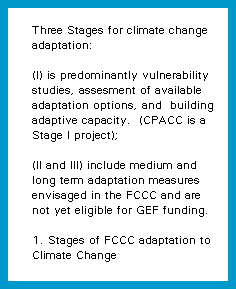
Global concern about accelerated climate change and its repercussions prompted the international community to begin negotiating a Framework Convention on Climate Change (FCCC.) in 1991. The Convention establishes a legal framework for responding to global climate change through the promotion of measures aimed at mitigating emissions of GHG and preparing for adaptation to the adverse effects of climate change. The FCCC agreed that adaptation to these adverse effects will require short, medium, and long-term strategies which should be cost effective, should take into account important socio-economic implications, and should be implemented on a stage-by-stage basis in developing countries that are Parties to the Convention. The sequence of activities are presented in box 1.
Furthermore, the FCCC agreed that for the Stage I the Conference of the Parties would entrust the Global Environmental Facility(GEF) to meet the agreed costs of the required activities.
The FCCC has been ratified by most Caribbean countries. More significantly, the Caribbean region, along with other small island and low-lying states, has been effective in drawing the attention of the international community to the potential adverse impacts of climate change on their economies. The region has also been active in the work of the IPCC, including the Coastal Zone Management Subgroup of the Response Strategies Working group.
Project Origin
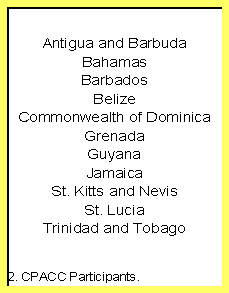
The Caribbean: Planning for Adaptation to Global Climate Change Project has its origin in the Global Conference on the Sustainable Development of Small Island Developing States which took place in Barbados in April/May 1994. During this conference, the small island developing states of the Caribbean requested OAS assistance in developing a project on adaptation to climate change for submission to the GEF. The project was submitted for consideration of the GEF endorsed by CARICOM's Ministers of Foreign Affairs. Participating countries are listed in box 2.
The GEF Council approved the project as part of its Work Program in May, 1995. The countries and CARICOM have maintained an active level of participation throughout the project preparation phase. A Project National Focal Point (NFP) has been designated for each country.
Project Preparation Phase
The OAS with its own resources and resources from the GEF Project Development Facility supported detailed project preparation from August 1995 to July 1996. Each of the eleven countries held a National Consultation to define their participation in the project followed by a report that was submitted by December 22, 1995. Three regional workshops were held with the participation of the National Focal Points and regional agencies to discuss and reach agreement on key aspects of the project. The OAS also prepared and disseminated informational brochures on the project.
The Project
Objectives
The project's overall objective is to support Caribbean countries in preparing to cope with the adverse effects of global climate change (GCC), particularly sea-level rise, in coastal and marine areas through vulnerability assessment, adaptation planning, and capacity building linked to adaptation planning. More specific objectives are listed below.
Specific Project Objectives
(i) strengthen the regional capability for monitoring and analyzing climate and sea level dynamics and trends, seeking to determine the immediate and potential impacts of GCC;
(ii) identify areas particularly vulnerable to the adverse effects of climate change and sea level rise;
(iii) develop an integrated management and planning framework for cost-effective response and adaptation to the impacts of GCC on coastal and marine areas;
(iv) enhance regional and national capabilities for preparing for the advent of GCC through institutional strengthening and human resource development; and
(v) identify and assess policy options and instruments that may help initiate he implementation of a long-term program of adaptation to GCC in vulnerable coastal areas.
Description
The project will follows a regional approach; being executed through the cooperative effort of all eleven participating countries and through a combination of national pilot/demonstration actions and regional training and technology transfer linked to adaptation planning. This approach seeks to strengthen regional cooperation and institutions, and to provide cost-effective means for adaptation planning, data collection, and sharing of information, skills and project benefits. The project will seek to build on existing institutions and experiences, and to liaise with other important regional initiatives and programs underway in the Caribbean. It consists essentially of enabling activities, complemented by selective capacity-building activities, aimed at creating or strengthening endogenous conditions and capabilities necessary to prepare a long-term program for adaptation to GCC. Project execution will take four years involving two components: adaptation planning and capacity building.
Components
(I) Adaptation Planning: short-term planning for adaptation to GCC in vulnerable areas. It will focus on regional sea/climate data collection and management, impact and vulnerability studies, and assessment of policy options. Throughout this component, the project will execute a comprehensive program of human resource development for upgrading skills of technicians and officials from participating countries in areas relevant to GCC and adaptation planning. Sub-components are described in Table 1.
(II) Capacity Building: the focus is on strengthening the capacity of the participating countries to carry out GCC adaptation planning. All participating countries will be assessed in building their national capacity to implement project activities and to ensure their continuation after completion. Activities under this sub-component include:
i) establishment of a Regional Project Implementation Unit (RPIU) responsible for project coordination at the regional level and for providing basic technical support and supervision in the key technical areas of the project;
ii) establishment of National Implementation Coordination Units (NICUs) within an existing institution in each participating country to coordinate project activities at the country level;
iii) strengthening of national and regional institutions directly involved in implementing various components of the project;
iv) upgrading the skills of professionals and technicians from participating countries through short courses, workshops, and hands-on training; and;
v) technology transfer among the participating countries for adaptation planning
| Component | Objectives | Participating Countries | Responsible Institutions |
| 1) Design and Establishment of Sea Level/Climate Monitoring Network (Regional) | The Sea level/climate observation network (18 gauges) Proposed for installation in each of the eleven participating countries will include a standardized set of instruments to measure water level, vertical land motion, air and sea temperature, wind velocity, precipitation, and other site-specific variables. The Caribbean Meteorological Institute will be the lead regional agency. | Regional | Regional and National meteorological agencies |
| 2) Establishment of Databases and Information Systems (Regional) | These data bases and information systems will allow key regional and national institutions to acquire, analyze, store, and disseminate data on climate change and its impact on natural and manmade systems. | Regional | Environment and Planning Ministries |
| 3) Inventory of Coastal Resources and Use (Regional) | To further develop each participating country's inventory of coastal resources so as to provide the necessary baseline data for the execution of other project activities. | Regional | Environment and Planning Ministries |
| 4) Formulation of a Policy Framework for Integrated Coastal and Marine Management (Regional) | To support the development of a generic policy framework for the preparation of Integrated Coastal Zone Management (IZCM) legislation throughout the region. | Regional | Environment and Planning Ministries |
| 5) Coral Reef Monitoring for Climate Change (Pilot) | To increase the knowledge about the extent and sources of coral reef degradation through the establishment of long-term coral reef monitoring programs which over time will show the effects of global warming factors. | Bahamas Belize Jamaica |
Coastal Zone Management and Environment agencies |
| 6) Coastal Vulnerability and Risk Assessment (Pilot) | The IPCC Coastal vulnerability assessment common methodology model will be reviewed and modified for application to the Caribbean Region. | Barbados Grenada Guyana |
Environment and Planning Ministries |
| 7) Economic Valuation of Coastal and Marine Resources (Pilot) | The design and implementation of pilot studies on the economic valuation of resources in selected coastal ecosystems at risk from sea-level rise. | Dominica St. Lucia Trinidad and Tobago |
Ministries of Finance and Planning |
| 8) Formulation of Economic/ Regulatory Proposals (pilot) | Two pilot studies will be implemented to demonstrate the design ands use of economic and regulatory approaches to environmental protection in response to threats from sea-level rise. | Antigua & Barbuda St. Kitts and Nevis |
Environment and Planning Ministries |
Project Organization
The General Secretariat of the Organization of American States (GS/OAS) is the Grant Recipient/Executing Agency for the project. The GS/OAS is executing the project under the supervision of The World Bank as GEF Implementing Agency, and under the guidance of a Project Advisory Committee (PAC). The PAC includes the following members: one representative from CARICOM to act as Chairman, the regional representative from the GEF Council, two representatives from the National Focal Points, one representative from UWICED to act as Vice Chairman, one representative from UNEP's Caribbean Environment Program, one representative from UNDP, and one representative from a regional/local NGO. The GS/OAS is responsible for overall project management and technical supervision. A Regional Project Implementation Unit (RPIU) has been established in the Centre for Environment and Development of the University of the West Indies (UWICED) in Barbados to ensure effective coordination and management of project activities at the regional level. As a prerequisite for participation in the project, each country was required to establish a National Implementation Coordination Unit (NICU) within an institution designated by the government. The NICUs, working in close collaboration with the RPIU, are facilitating and coordinating project implementation at the national level.